Air-Drying Without the Frizz: A Technique Edit
Air-drying is sold as the no-effort option, which is why so much air-dried hair looks unmanaged. The truth is the opposite: heat styling is forgiving because it forces the cuticle flat before anything can disturb it. Air-drying leaves the cuticle exposed for hours, and every touch, rub, and gust in that window writes itself into the finished hair. Frizz is not a hair type — it is a record of disturbances during the set.
Frizz is a cuticle-behavior problem
The cuticle is a layer of overlapping scales: wet, the scales lift and the strand swells and stretches; dry, they settle flat and light reflects. Frizz happens when scales are caught mid-lift — by water moving out unevenly, by friction prying the edges up while the strand sets. Humidity deserves its own mention: it is the saboteur people blame least correctly. Hair dries toward the moisture balance of the air around it, so a humid day pulls water back into a half-dry strand, re-swelling the cuticle hours after you thought the set was done. The fix is patience — leave hair alone until it is fully dry, because a strand that sets while still damp in humid air will frizz on schedule.
The sequence that does the work
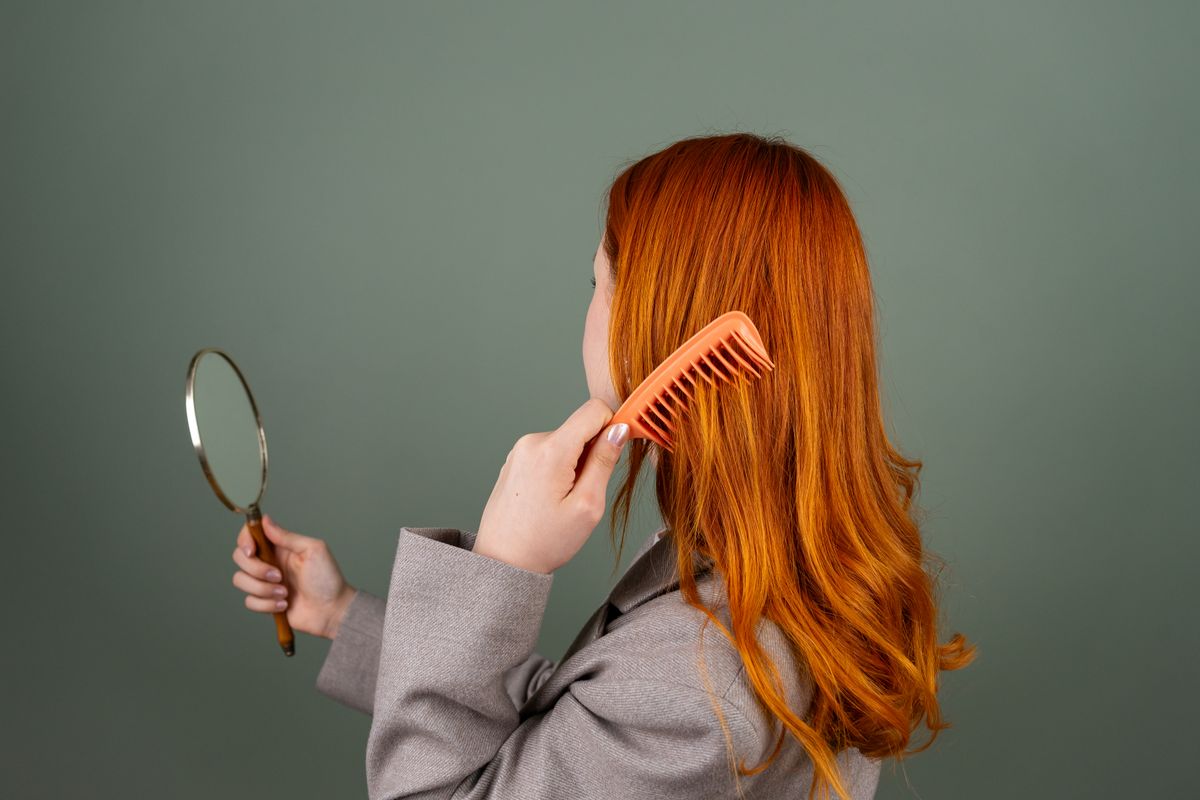
Product goes on before air does, and the order is the technique. On soaking-wet hair: a leave-in for slip, worked through with fingers or a wide comb while everything is still uniform. On that same wet canvas, the hold product — gel, mousse, or cream depending on texture — goes on while the hair can still be rearranged. Once water starts leaving, the shape locks. Then hands off. The one sanctioned exception: the scrunch or clamp to encourage pattern in wavy and curly hair, head tilted, product-coated hands only. What never helps: running back to check with dry fingers, brushing once the surface has started drying, or flipping heavy hair around mid-set — each one re-swells the cuticle it lands on.
The drying surface: microfiber, t-shirt, or towel
Traditional terry towels are the wrong tool: their loops hook lifted cuticles and their absorbency pulls water out of the surface unevenly — the frizz mechanism in fabric form. A cotton t-shirt is the classic upgrade — smooth, non-looped, and gentle, especially for plopping curls. Microfiber does the same job faster, wicking water without roughing the surface, which matters most for dense hair. Squeeze and scrunch, never rub; the motion matters more than the fabric.
Notes by texture
Wavy (2a–2c): the pattern collapses under weight, so the fight is against water-load. Squeeze, do not rake; apply mousse or a light gel while wet; clip at the roots for lift; break the gel cast once fully dry with a drop of oil in palms. Curly (3a–3c): sections while wet, product per section, then plop in a t-shirt for ten to twenty minutes before letting the air finish. Scrunch upward only; downward friction is where the frizz enters. Coily (4a–4c): shrinkage means the strand sets in its pattern early, so stretching choices — banding, loosely braided sections, the shingling method — happen on wet hair and stay untouched. A heavier cream and an oil or butter seal go on in that order while wet, and the porosity guide explains why coily hair often needs the water worked in before anything seals it.
One honest limit: no sequence beats weather. On a rain-heavy day the set runs softer and wider, and that is physics, not failure. The desk’s heat damage guide covers the blow-dry option for the days the air refuses to cooperate.
Frequently asked
- Is air-drying actually better for hair than blow-drying?
- It avoids heat damage, but it is not automatically gentler. Hair is at its most fragile when wet, and hours of being heavy, swollen, and rubbed against fabric do their own mechanical damage. The honest answer: air-dry with good technique, or blow-dry on a moderate heat with a protectant — a slow, rough air-dry can be harder on hair than a quick, careful blowout.
- Why is my hair frizzy only when I air-dry?
- Because air-drying gives the cuticle hours of exposure instead of minutes, and any disturbance during that window — touching, fabric friction, drying wind, humidity arriving before the hair sets — lifts it. Frizz on air-dried hair is almost always a disturbance problem, not a product shortage. Less handling and the right drying surface fix more than another layer of cream.
- How long should hair take to air-dry?
- Fine hair, one to two hours; medium hair, two to three; thick or coily hair, three or more. If yours takes dramatically longer, the problem is usually a product layer applied too heavy or too early — a thick cream cocktail applied to soaking hair holds water in and stretches the timeline. Lighter, later application shortens it.